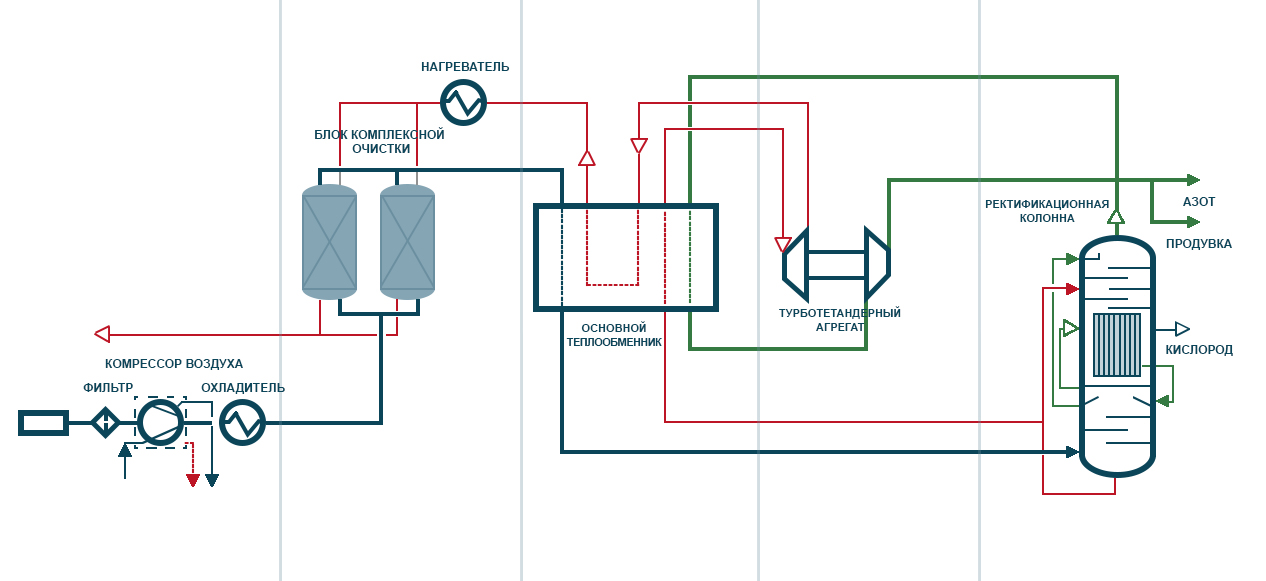
Air separation units (ASUs) are used to separate the air mixture into individual components (oxygen, nitrogen, neon, etc.). Their operating principle is based on differences in the physical properties of the components, their molecular masses and thermodynamic characteristics. Such systems are in demand in metallurgy, medicine, electronics, the food and chemical industries and play an important role in the production of pure gases. This article highlights the main principles that characterize the operation and application of ASUs.
Operating principle of air separation units
According to the air separation method used, units are classified into:
- Adsorption,
- Membrane,
- Cryogenic.
Adsorption method
The adsorption method of air separation is based on the selective adsorption of air components by synthetic zeolites, as well as natural zeolites and carbon molecular sieves. Adsorption units are designed to produce only one air separation product and only in gaseous form. Accordingly, adsorption air separation units are divided into oxygen units and nitrogen units. To ensure a continuous air separation process by the adsorption method, at least two cyclically operating adsorbers are required. While one adsorber is in product generation mode, the second one is being regenerated. The product can be produced either at elevated pressure (pressurized scheme) or at atmospheric pressure (non-pressurized scheme). Regeneration of the adsorbent in the pressurized scheme is generally carried out at atmospheric pressure, and in the non-pressurized scheme at vacuum. Units operating according to the pressurized scheme are called KCA units, and those operating according to the non-pressurized scheme are called VKCA units.
Oxygen adsorption units
The process of producing oxygen by the adsorption method is based on the difference in the equilibrium sorption capacities of nitrogen and oxygen on synthetic zeolites. Low-capacity units (up to approximately 500 Nm
3/h) are built according to the pressurized scheme (KCA). High-capacity units are built according to the non-pressurized scheme (VKCA). The oxygen purity that can be obtained on a KCA unit reaches 95%, however in practice the oxygen purity usually does not exceed 93–94%, especially on high-capacity VKCA units. The recovery rate of 93% purity oxygen on existing adsorbents does not exceed 10–12%. KCA units deliver oxygen at pressures up to 5 bar. VKCA units deliver oxygen at atmospheric pressure.
Nitrogen adsorption units
Carbon molecular sieves (CMS) are used as the adsorbent in nitrogen adsorption units. The process of producing nitrogen by the adsorption method is based on the difference in the rate of diffusion of molecules into the pores of the CMS. In other words, the rate of oxygen adsorption on CMS is much higher than that of nitrogen adsorption. Nitrogen adsorption units are built predominantly according to the pressurized scheme. Nitrogen purity can range from 0.0005% to 5% oxygen. Unlike oxygen adsorption units, the nitrogen recovery rate in nitrogen units strongly depends on the required nitrogen purity and can range from 11% to 45%.
General principles of adsorption units:
- production of only one separation product
- production of the separation product only in gaseous form
- limitations on the purity of the separation products
- operation in only one mode
Membrane method
The membrane method of air separation is based on differences in the diffusion rates of gas components through the membrane material, which is a porous polymer fiber with an ultra-thin gas-separating layer applied to its outer surface. Membrane units are intended only for producing nitrogen or air enriched with oxygen up to 50%. Both nitrogen and oxygen-enriched air leave the membrane unit only in gaseous form.
The application area or capacity range of membrane units practically coincides with that of nitrogen adsorption units; however, the nitrogen purity from an adsorption unit will be higher than from a membrane unit of similar capacity.
General principles of membrane units:
- production of only one separation product
- production of the separation product only in gaseous form
- limitations on the purity of the separation products
- operation in only one mode
It should be noted that if the membrane fails (and its cost constitutes a significant portion of the total unit cost), it must be replaced.
Cryogenic method
The cryogenic method of air separation is based on low-temperature rectification, which in turn relies on the difference in boiling points of the air components and on the difference in compositions of liquid and vapor mixtures in equilibrium. Unlike adsorption and membrane units, in which the separation process takes place at ambient temperature, in cryogenic units the separation process occurs at low (cryogenic) temperatures. In cryogenic units, unlike adsorption and membrane units, it is possible to obtain several separation products simultaneously (oxygen, nitrogen, argon) and to obtain these products both in gaseous and in liquid form. The cryogenic method allows virtually any required purity of separation products to be achieved, in any amount.
General principles of cryogenic units:
- complex air separation (simultaneous production of several separation products)
- production of separation products both in gaseous and in liquid form
- no limitations on the purity of the products obtained
- multi-mode operation of the unit
Advantages and disadvantages of adsorption units
The use of a short-cycle adsorption unit (VKCA) for oxygen production is justified when an oxygen purity of no more than 93% is required and at relatively low capacity. Choosing VKCA is also justified when long-term operation is not required and frequent starts and stops of the unit occur. During operation, impurities (oil, water) may enter the adsorbers; cleaning in turn requires replacement of the adsorbent, washing of the adsorbers and servicing of the valves. However, the use of a modern filtration system and a protective layer minimizes these risks.
Abrasion of the adsorbent is possible, depending on the internal technologies used, the components applied, the adsorbent manufacturer, the air supply system, air flow rates, filling and compaction of the adsorbent, and the design of the adsorber, etc. In a short-cycle adsorption unit (VKCA), due to its technical features, oxygen leaves the unit at atmospheric pressure, and to ensure the required pressure it is necessary to use booster oxygen compressors.
Advantages and disadvantages of membrane units
Membrane units are not intended for oxygen production. In membrane units, it is only possible to obtain oxygen-enriched air, so membrane units will not be considered further.
Advantages and disadvantages of cryogenic units
The main advantage of cryogenic air separation units is that they can produce air separation products in any quantity and at any purity. Only cryogenic units can simultaneously produce several air separation products. Only cryogenic units can produce liquid air separation products. Unlike adsorption and membrane units, increasing product purity in cryogenic units does not significantly affect the recovery rate or the unit cost.
The disadvantages of cryogenic units include a long start-up period, which is due to the fact that the unit operates at cryogenic temperatures. Achieving these temperatures (cooling down the equipment) requires a certain amount of time (8–24 hours).
Economic feasibility of different oxygen production methods
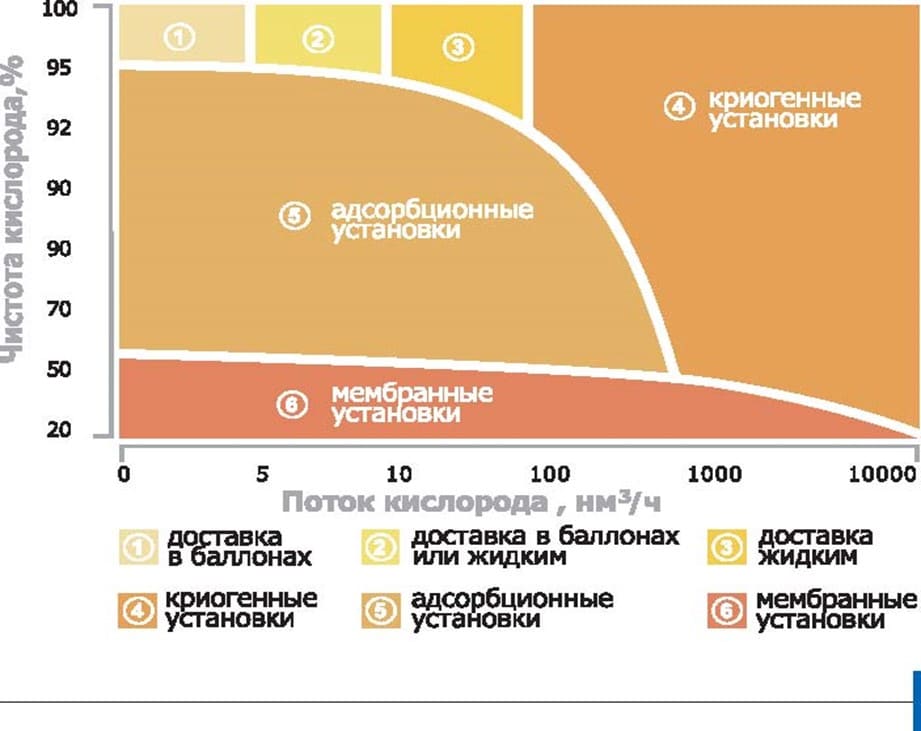
The figure shows a diagram illustrating the optimal ranges of capacity and nitrogen purity for different types of air separation units.
This diagram shows that for a capacity of 20,000 Nm
3/h of gaseous oxygen with a purity of 92% and higher, it is advisable to choose a cryogenic unit.
Conclusion
Having considered the existing methods of producing air separation products on an industrial scale, it is possible to define indicative limits for the applicability of each method. It should be noted that the choice of method should be based on a combination of several factors, the main ones being the cost of the unit (capital expenditures) and operating costs. When choosing KCA and membrane technologies, it is important to take into account a significant increase in specific energy consumption as product purity increases. For example, at the same capacity, the choice between cryogenic and adsorption air separation will depend on the purity of the product obtained.
Taking the above into account, we have opted for the cryogenic method of air separation. The main selection criteria are low capital and operating costs. It should be noted that as product purity increases, the preference for a cryogenic unit becomes even more evident, and at product purities above 95% a cryogenic unit is the only option.
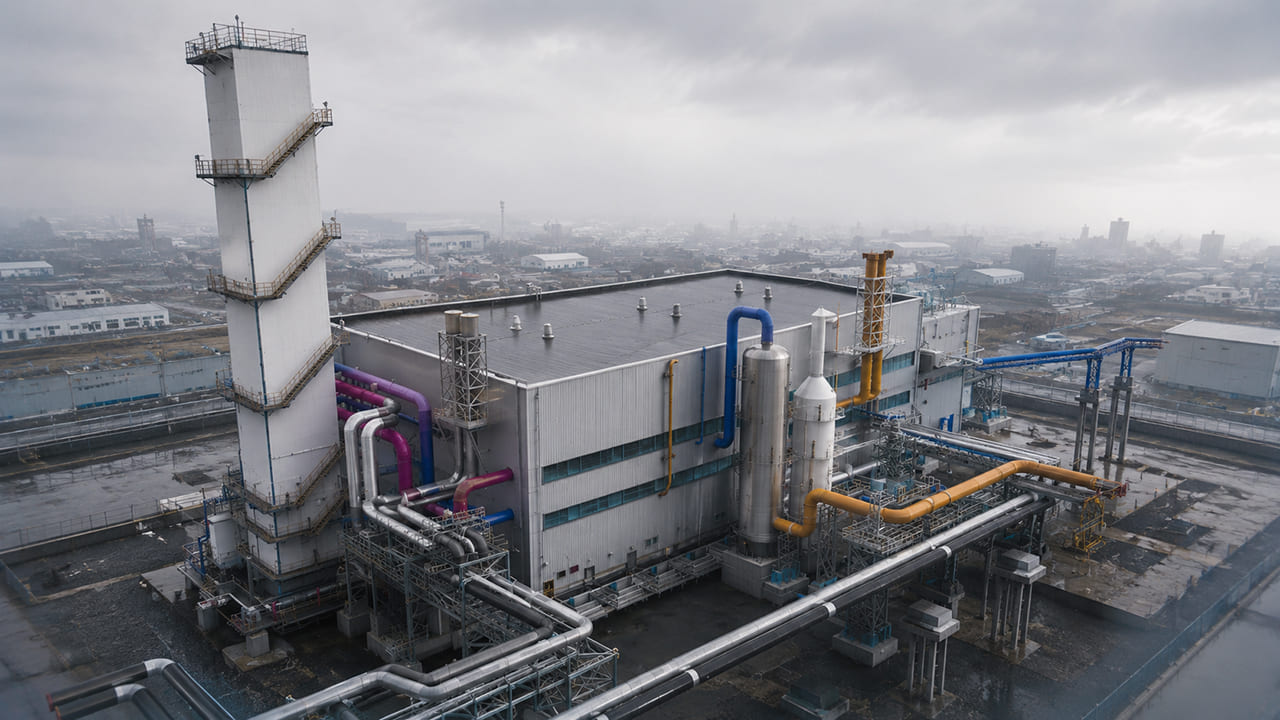 Cryogenic air separation units for oxygen
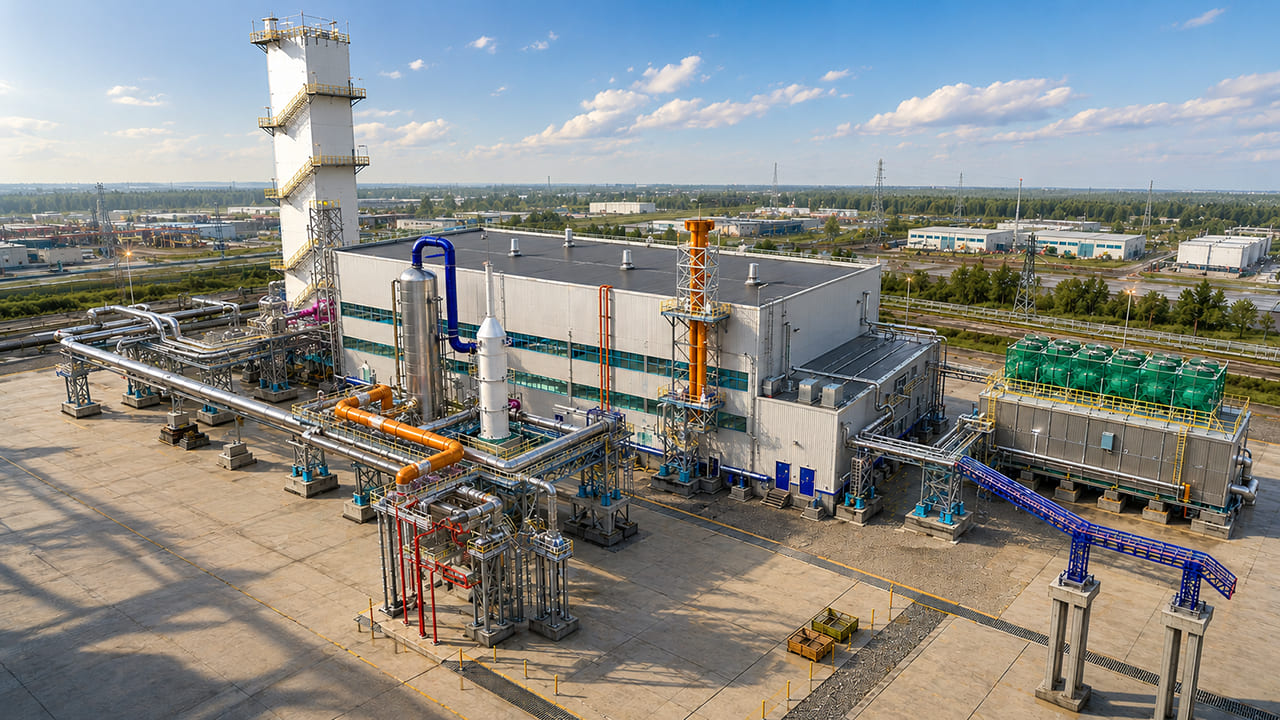 Cryogenic air separation units (ASUs) for nitrogen
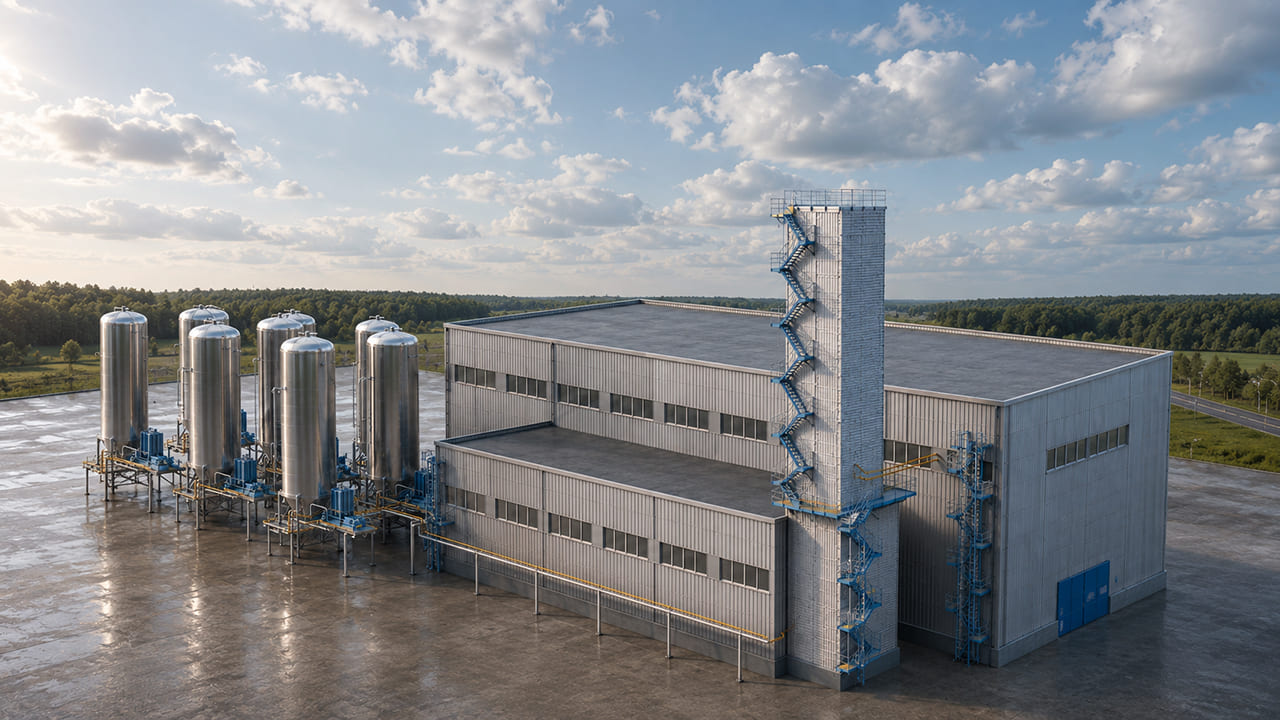 Cryogenic Air Separation Units